
Read Boone County's Owner-of-Record Card
The Boone County GIS/PRC viewer opens the owner record. Search by situs or parcel number. Select the mapped parcel, then preserve each displayed value without filling gaps from another source.
| Owner display | The person, trust, estate, or entity attached to the assessment parcel |
|---|---|
| Mailing address | Destination for tax correspondence, not necessarily the property |
| Situs address | The physical location used to find the parcel |
| Parcel identifiers | County parcel number and, where displayed, state parcel ID |
| Transfer or sale entry | A date and transaction clue to reconcile with the recorded instrument |
| Assessment year | The vintage of the value and tax-administration display |
The card's live fields set the limits. Not every result carries a vesting phrase or deed reference. Owner of record is not the same as occupant. The mailing address serves legitimate property correspondence, while the situs identifies the land itself.
Boone's Property-Card Access Point
The Assessor's property record card page is the official source. Current owner searches route to GIS. Sales-disclosure PDFs arrive through that same route, and public terminals offer another channel with printing at $0.10 per page.
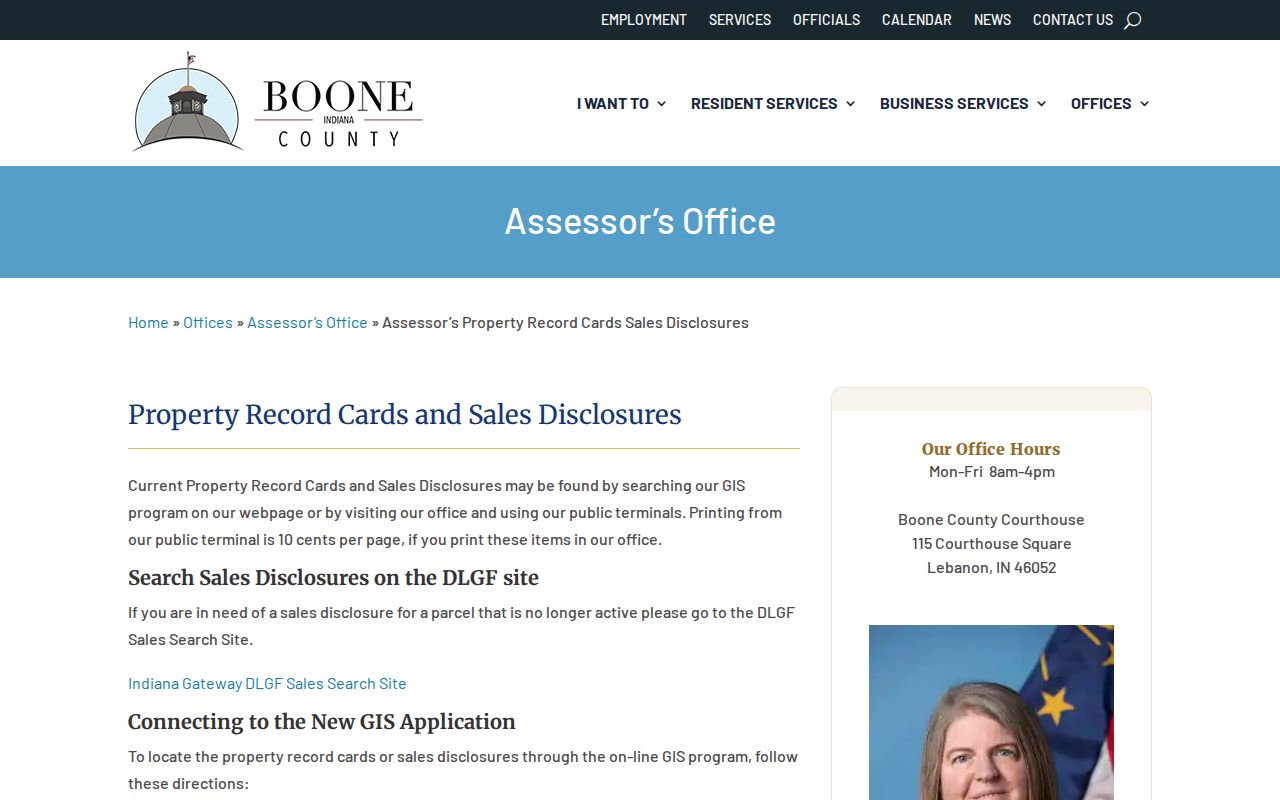
The county's own route leads to GIS. Verify the parcel's live owner field and note the date viewed before relying on it.
Note: Inactive-parcel sales research is directed to Indiana's DLGF Sales Disclosure Search rather than assumed present on the current card.
Measure How Current the Boone Owner Record Is
Three clocks can attach to one transaction. The Recorder stamps a recording date, while the Assessor or Auditor logs a transfer date. The parcel card carries its own assessment year. A closing can land before the owner name refreshes. Capture all three, and never declare that ownership changed on whichever date appeared first.
The Boone Assessor certifies assessed values to the Auditor. The Recorder records the conveyance for public notice on a separate workflow. When the tax roll still names the seller, the newest recorded deed is the more current evidence, as long as it matches the same parcel and legal description.
Recent-sale gap. The assessment roll can lag a newly recorded conveyance; confirm a suspected change with the latest Recorder instrument.
Confirm Boone's Current Owner Against the Deed
Use the owner record as an index to the deed, never a substitute. Doxpop offers a searchable convenience layer, but the Boone County Recorder remains the custodian of the actual deed records.
- Capture the owner spelling, parcel number, legal description, transfer clue, and assessment year from GIS/PRC.
- Search that name as grantee in Doxpop Recorded Documents.
- Choose the newest conveyance that matches the parcel's legal description, then compare its grantee and recording date.
- Request an official or certified copy from the Boone County Recorder when the answer will be relied upon.
- Owner of record
- The party the current administrative record associates with the parcel.
- Assessment roll
- The tax-administration record, carrying a specific year or update vintage.
- Situs
- The property's physical address, distinct from the owner's mail destination.
- Recording lag
- The interval before a conveyance appears across other county systems.
Add the Boone Auditor's Transfer Date
The Boone County Auditor bridges the tax duplicate and the recorded deed. Ask for a deed's name and transfer date. The Recorder provides the copy. That date can settle a mismatch between the owner display and a newly indexed instrument.
Bring the parcel number and legal description for an office visit. The Auditor sits at 201 Courthouse Square. The Recorder sits at 202 Courthouse Square in Lebanon. Rather than blending the sources, ask each office the question its own record answers.
Check Boone Entity and Representative Names Exactly
An LLC, corporation, trust, estate, or representative may occupy the owner field. Run the exact displayed name through the Indiana INBiz business search. Keep the roles straight. A registered agent is a public entity contact, not necessarily the property's current owner. A public deed may also name a trustee without exposing the trust's private beneficial interests.
Probate creates another timing gap. Boone Superior Court I handles probate and estates. A docket or death certificate alone does not transfer title. Find the affidavit, personal-representative deed, or other recorded conveyance. It must link the estate proceeding to the parcel.
Monitor New Boone Recorder Filings
Doxpop Property Watch gives free alerts. Email or text notices cover name-linked deed activity, and SMS was added in April 2025. Skip middle initials. The service warns that spelling errors, old deeds, or missing records can defeat a match. An alert is a prompt to examine the new instrument, not proof that the owner of record changed.
Note: Record the alert date and instrument number, then verify both with the Recorder before updating an ownership conclusion.
Use Boone Owner Information With Restraint
Use the tax-roll mailing address for legitimate parcel correspondence. Protected information must stay protected. Indiana's Address Confidentiality Program gives eligible survivors a substitute address, and it is not an obstacle to work around. Share only the fields a transaction, estate inquiry, assessment issue, or property-history question actually requires.
Lawful use. A public mailing address may support appropriate property correspondence. Never use current owner information to stalk, harass, intimidate, or harm a person.
A lookup result has limits. It cannot prove occupancy, settle an adverse claim, or replace professional title work; for the broader address-to-owner method, see who owns this property.
If GIS is unavailable, the Assessor's public terminal is the direct fallback. Bring the situs, parcel ID, and transfer date. For a just-recorded conveyance, ask the Recorder for the newest matching instrument. Ask the Auditor for the transfer-date bridge. Keep each office response and its date. A stale screenshot should never pass as current fact.
Address corrections deserve the same discipline. The Auditor requires its prescribed mailing-address process rather than a verbal request or ordinary letter. A new mail destination never changes the situs, deed grantee, or ownership date; it only redirects where tax correspondence goes.
Document a Boone Current-Owner Finding
A name on a screen proves little by itself. To document a current-owner finding in Boone County, save the source URL. Also record the date you viewed it. Record the exact situs, the county parcel number, and the state parcel ID when the site shows one. Add the legal description, the owner spelling, any mailing address, the assessment year, and a transfer clue. Include the recording reference too. Missing fields should be marked "not displayed." Never fill a gap with data from another parcel. Do not use an older screenshot either. That discipline keeps later refreshes honest.
Roles matter more than labels. The owner of record is simply the party attached to the assessment parcel at that source's vintage. A tax-mail recipient can sit at a different address. A trustee may hold title in a representative capacity. During estate administration, a personal representative may appear instead of the decedent. A registered agent listed in INBiz is an entity contact, not necessarily the grantee. Appearing in a public file makes nobody the owner. That holds whether the party is a mortgagee, lien claimant, permit applicant, or occupant.
A recent deed can change the grantee, so read the full instrument and its legal description. Indiana recording rules explain the extra markings: acknowledgments, preparer information, and a sales-disclosure endorsement when applicable. An Auditor transfer-tax endorsement appears as well. Those details tie the recorded event to later administrative updates, though the dates rarely line up. Use a closing date only when the source actually states it. The recording date or assessment date is never a substitute.
Freshness deserves a limit suited to the task. Casual property-history work may only need a dated citation. A pending purchase, an estate distribution, or a disputed ownership question calls for a fresh Boone County Recorder check. Professional review should follow. "Current" describes evidence observed at a stated moment, not a permanent guarantee.