
Read the Boone County Property Tax Record by Office
Boone County stores its property tax record in pieces, not on one screen. The Boone County Assessor maintains the assessment characteristics. The Auditor keeps the tax duplicate and deductions. The Treasurer issues and collects the tax bill. Each office holds part of the parcel story. Match every figure to its custodian before you compare numbers.
| Record field | Meaning | Official source |
|---|---|---|
| Land, improvements, total assessed value | Assessment components reported for a tax year | Assessor PRC and DLGF |
| Transfer date and tax duplicate | Administrative ownership and tax-roll bridge | Auditor |
| Deductions and exemptions | Relief that may change taxable liability | Auditor and Assessor |
| Bill, receipt, and payment status | Tax charged, posted payment, penalty, or delinquency | Treasurer |
| Assessment notice and appeal | Value notice, review filing, and decision | Assessor, PTABOA, IBTR |
Indiana assesses at market value-in-use. From there, rates, deductions, and caps shape the final bill. Keep in mind that neither the assessment nor the bill is necessarily what a buyer would pay for the property.
Search Boone County Property Tax Records With the Right Key
The county's property record card instructions route searches through Boone GIS. If a query comes back empty, the format is often the culprit, not a missing parcel.
| Lookup | Verified entry rule | Result to retain |
|---|---|---|
| Address | Use numbers only, without street name | Candidate parcel and PRC |
| Owner | Use last name only | Displayed parcels |
| County parcel | Omit dashes | County tax key |
| State parcel ID | Keep dashes and period | State-format identifier |
The PRC button pulls up assessment details. The Sales Disclosure button covers qualifying transfers. The Assessor publishes disclosures dating back to January 2000 and sends inactive-parcel sales to the DLGF gateway. The static instructions do not list live result fields or refresh dates, so note the date you access them.
Check Boone County Values in the State Search
The state's DLGF Assessed Value Search takes a partial address or street. It even accepts a partial last name. Results include Details and Download options. The results show the total assessed value of land and improvements. DLGF labels the figures as county-reported data.
Every value belongs to a tax year and is used for the following pay year. Record both years whenever you compare a parcel card or a DLGF row. Do the same for a bill or an appeal notice. This two-clock check resolves most apparent mismatches.
- Assessed value
- The value assigned for tax administration.
- Market value-in-use
- Indiana's assessment standard for the property's use.
- Tax levy or rate
- The local calculation applied through the tax system.
- Tax lien
- A legal claim arising from unpaid property tax.
Retrieve a Boone County Tax Bill and Status
The Treasurer's payment information lays out office, mail, and external online routes. Start from the verified parcel and keep the bill year in view. That matters most when a mortgage escrow date differs from the county's posting date.
- Find the parcel in Boone GIS and copy both parcel identifiers plus the tax year.
- Follow the Treasurer route and match the parcel or invoice before reading the balance.
- Compare deductions on Auditor records and value components on the Assessor PRC.
- Ask the Treasurer to confirm delinquency or tax-sale status before relying on an old notice.
County guidance sets May 10 and November 10 as installment dates. Confirm the calendar for the year in question, including any weekend or holiday shift. Do not assume a date you saved earlier still controls.
Compare Boone County Property Tax Payment Channels
InvoiceCloud charges 2.95 percent for credit or debit cards. It applies a $1.95 minimum, and $0.95 for ACH. These are checkout service charges, and they never change assessed value. Paying in person or by mail are separate channels. Check the official Boone County tax payment page before you pay.
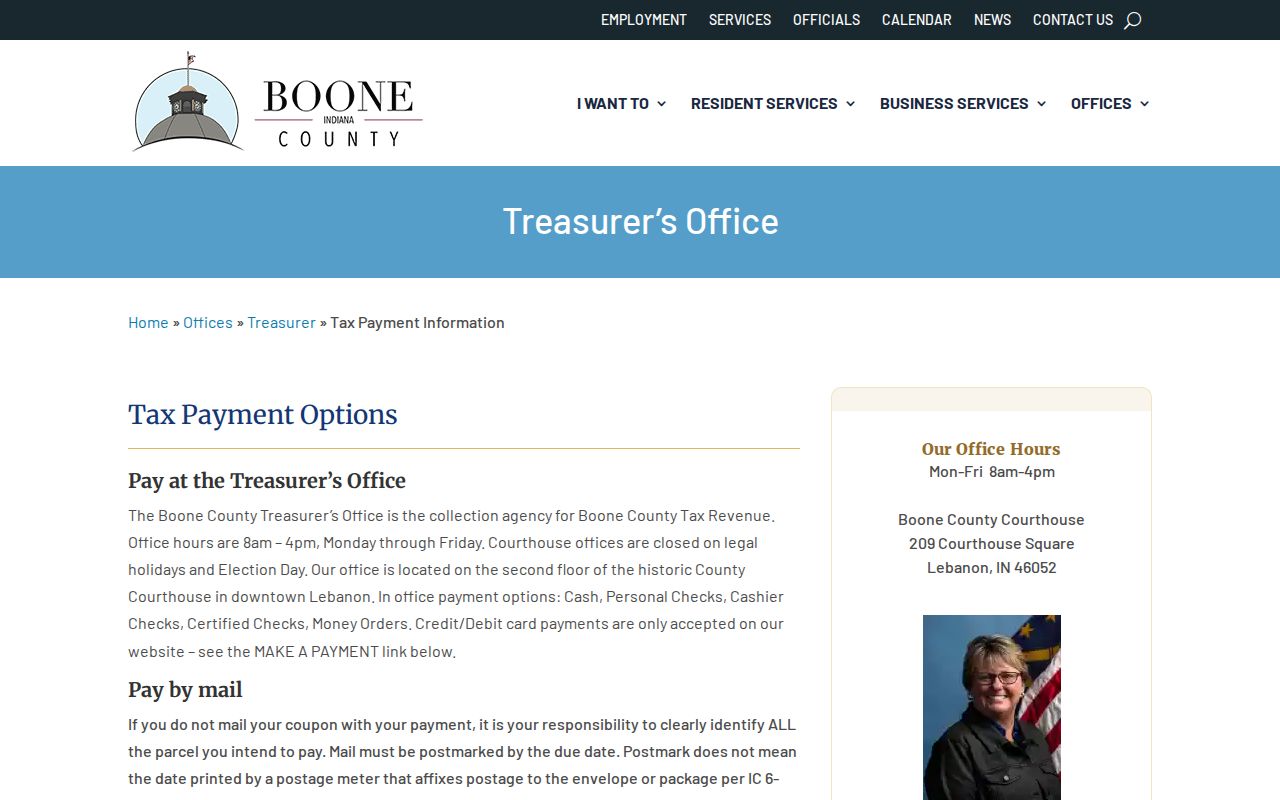
The county page hands visitors off to their payment choices. When a receipt arrives, match its posting date to the correct parcel and pay year.
Keep Boone County Deductions Apart From Tax Caps
Auditor forms cover homestead, over-65, blind or disabled, disabled-veteran, rehabilitated-residential, and change-of-use filings. County guidance calls for filing or postmark by January 5 after the tax year. A deed or title change can trigger re-filing.
The county tax-cap page explains the one, two, and three percent classes. A cap and a deduction work at different points in the math. So verify each on its own official record.
Note: Form eligibility depends on the parcel, owner, use, and tax year; use the current county form and instructions.
Distinguish Boone County Delinquency From Tax Sale
An unpaid balance is one status. A lien is another. A parcel listed for tax sale is a third. The Treasurer's tax-sale page points to an outside vendor. But the Boone notice on display still references 2021. That stale notice cannot settle a current list, deadline, redemption term, or parcel status.
Ask the Treasurer for the current parcel-specific record. Keep the bill year, posting date, notice date, and any redemption paperwork separate. When a question reaches beyond tax administration, court foreclosure records or the deed deserve a look too.
Use Every Boone County Tax Record Access Channel
Online tools help. Boone County also serves records at the counter, by mail, at public terminals, and through written requests. The Assessor sits at 115 Courthouse Square. The Treasurer sits at 209 Courthouse Square in Lebanon. Both keep weekday hours from 8 a.m. to 4 p.m. The Auditor, at 201 Courthouse Square, handles deductions, transfer dates, tax duplicate questions, and property-address issues.
An Assessor terminal offers current property cards and sales disclosures. Printing costs ten cents per page. Mailed tax payments must include parcel identification. Under county guidance, bank bill-pay checks must arrive by the due date. An ordinary mailed payment follows the stated postmark rule. Keep proof of whichever channel and date you use.
A record may be missing online. The Boone APRA form supports an inspection request or copies by mail or email PDF. Name the custodian, parcel, tax year, and record type. APRA does not force an office to build a new analysis or answer a broad question.
Phone calls still work when a balance or posting cannot be confirmed from the public page. The Assessor lists 765-482-0140, the Auditor 765-482-2940, and the Treasurer 765-482-2880. Ask a narrow question. Then note the staff office, date, parcel key, and tax year instead of recording an unsupported conclusion.
Run a Three-Clock Check on Boone County Tax Records
Parcel data in Boone County rarely moves on one calendar. Each office stamps its own date on the same transaction. The Recorder's recording date, the Assessor or Auditor transfer and assessment date, and the Treasurer's posting date for a bill or payment can each land weeks apart. Line them up on a short timeline. If city work matters too, add the permit or plan-commission date. It becomes a fourth clock on the same line.
| Clock | Date to capture | Question it answers |
|---|---|---|
| Recorder | Instrument recording date | When the conveyance or lien entered the public record |
| Assessor or Auditor | Transfer and assessment dates | When tax administration reflected the change |
| Treasurer | Bill year and payment posting | When the charge and payment appeared |
| Planning office | Permit or docket action date | When approved work entered the land-use file |
Do not expect the clocks to match. Boone County systems update on their own schedules. The gaps between dates are often the whole story. A recent purchaser may still see the prior owner of record. The Treasurer's tax roll lags the Recorder's deed records. A lender's payment may not have posted yet. New improvements can show up in planning records first. The next assessment card reflects them later. Keep the source noted beside every date you collect.
When a date is simply absent, mark it as not displayed. The responsible office is the fallback. That habit keeps a payment screen, a planning approval, or a sale disclosure from being mistaken for something else. The date title actually changed is a separate fact.
Boone County Begins the 2026 to 2030 Reassessment Cycle
Indiana's cyclical reassessment schedule opens the 2026 to 2030 cycle on July 1, 2026. About one quarter of parcels get a physical review each year. Boone County also applies annual trending, so assessed values can shift even between review years.
The cycle is context, not proof. It says nothing about whether a particular parcel's value is right. Judge a specific assessment on parcel characteristics, land and improvement components, the assessment year, neighborhood evidence, and the Form 11 notice itself.
Challenge a Boone County Assessment on the Form Path
The Boone County appeal process starts with timely Form 130 action after the assessment notice. June 15 is the general deadline tied to Form 11 timing. From there, PTABOA hears the local appeal, and Form 131 can carry an eligible dispute on to the Indiana Board of Tax Review.
Appeal window. Use the date on the actual Form 11 and confirm the deadline with the Assessor. A late filing can forfeit review for that assessment period.
Build the claim on parcel facts. Comparable evidence, photos, and plans all belong in the file. A plain account of the alleged error belongs there too. Form 115 records the PTABOA decision. Separate forms govern exemptions, destroyed property, and certain corrections.
The Assessor's online forms page lists additional routes. Form 132 handles an exemption appeal. Form 135 reports destroyed or removed property. Form 137R concerns disaster reassessment. Form 133 addresses certain objective errors. Picking the right form matters, because each route asks a different legal and factual question.
Assemble a complete evidence packet before you file. Include the PRC as accessed, Form 11, photographs, measurements, and comparable-property data. Sales evidence, correspondence, and proof of timely filing complete the packet. Label every item with its assessment year. When a decision arrives, compare it against the specific claim you presented, not against an unrelated current tax bill.