
Build a Boone Former-Owner Timeline
Lay out a simple working table with one row per transfer. Fill a row only when a recorded deed confirms it. Never assume a sale happened just because no image appears online; silence is not evidence.
| Source | Years It Covers | Where Held | What It Shows |
|---|---|---|---|
| Doxpop index and images | Reported January 1996-present | Online; Recorder verifies | Indexed parties, dates, and instrument references |
| Older deed books and microfilm | Pre-1996, subject to surviving series | Boone County Recorder | Earlier conveyances and book/page links |
| Historic plats and surveys | Varies by collection | Recorder, Surveyor, State Library | Subdivision, lot, tract, and corner context |
| Tax, probate, and court sources | Varies; major pre-1856 loss | Auditor, Clerk, archives | Administrative evidence and gap clues |
The Doxpop recorder index anchors the recent stretch of any chain. For older books, certified copies, and questions the index cannot answer, the Recorder's office is the authority, while State Library and Surveyor collections help identify historical tracts.
The Boone January 1996 Online Boundary
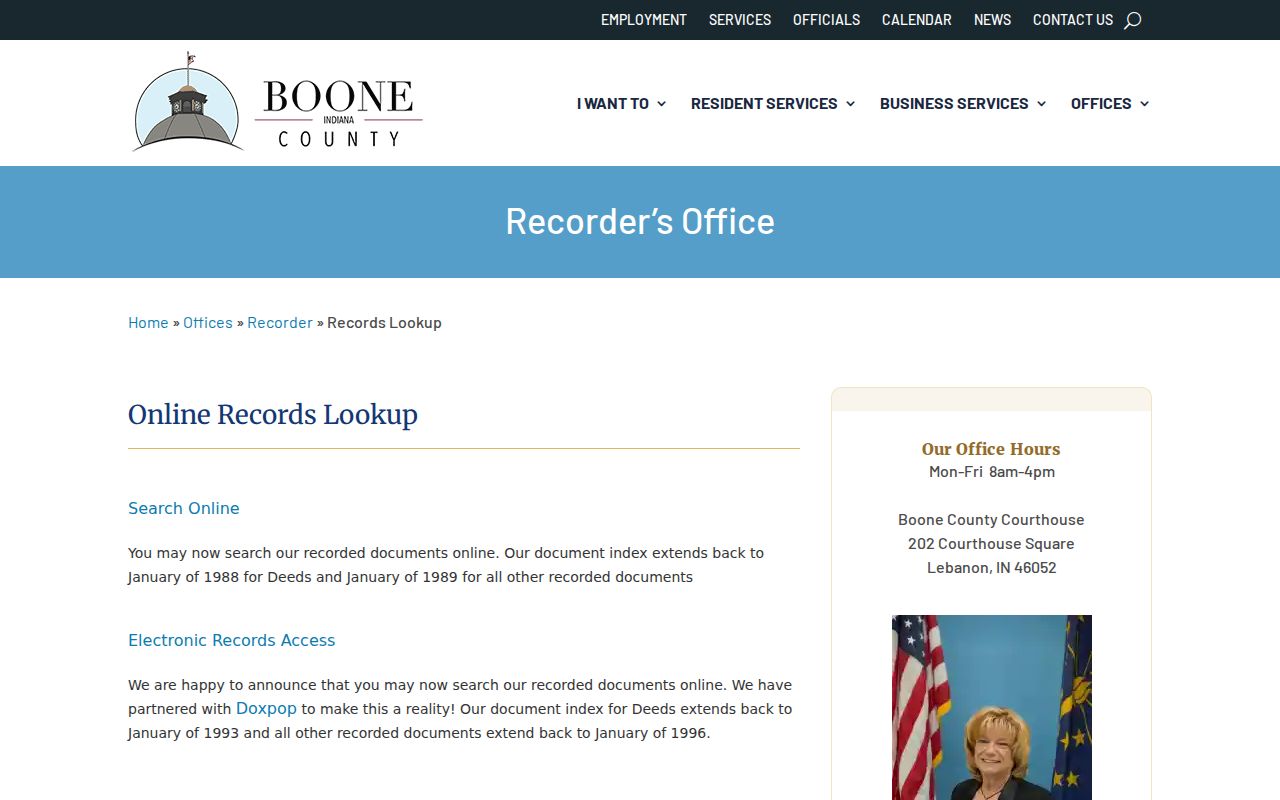
Doxpop's partner table lists Boone index data and scanned images starting January 1996. The county's own legacy notices disagree with themselves. One says deeds date to January 1988, with other documents from 1989. Another points to deeds from 1993. Everything else comes from 1996. Rather than pick a winner, keep the conflict noted. Ask the Recorder directly about the document type and older book series you need.
The Boone Recorder records-lookup page is the county's official link into the online system.
Ask the Recorder before trusting any coverage date.
Online cutoff. Treat January 1996 as the cautious online start until the Recorder confirms the relevant pre-1996 deed or book series.
Walk Boone's Deed Chain in Reverse
Record the legal description and any prior-instrument citation at every backward step. Names alone are dangerous, since a common surname can tie together parcels that were never related.
- Find the present owner's acquiring deed, with that owner shown as grantee.
- Record its grantor, legal description, recording date, instrument number, and book/page.
- Search that grantor as an earlier grantee, checking spelling variants and entity suffixes.
- Repeat to the online boundary, then carry the final book/page and legal description to the Recorder.
- Grantor / grantee
- The conveying party and receiving party named in a deed.
- Chain of title
- The ordered succession of ownership instruments.
- Reverse index
- A route to deeds through party roles and names.
- Quitclaim / warranty
- Different conveyance forms; neither label alone proves a complete chain.
Carry Boone Descriptions Into Older Books
Street names and house numbers make poor keys for old research. Platted lots demand the subdivision name, phase, lot, block, and every amendment. Metes-and-bounds tracts need section, township, range, acreage, boundary calls, monuments, and the cited survey. Happily, later deeds often recite an earlier book and page, and that recitation is the bridge past any online index's edge.
The Indiana State Library Boone map and plat-book holdings and the County Surveyor's corner books can orient a tricky tract. Treat them as supporting material. A plat shows how land was divided, not who held it afterward.
Note: Search former subdivision names as aliases and copy legal wording exactly; a modern neighborhood label may never appear in an older deed.
Why Boone's 1856 Fire Breaks Some Chains
Boone County was formed in 1830. A courthouse fire in 1856 destroyed nearly all pre-1856 Recorder, Auditor, and Treasurer records. That loss is archival, not proof that nobody owned land before then. So a fully unbroken chain from modern deed back to the original patent may simply be impossible. County books alone cannot close the gap.
Build a ladder of substitutes. Begin with the last surviving instrument and later deed recitals. Then work through the surviving Tract Book, court and order books, wills, guardianships, and probate material. Add newspapers, tax duplicates, surveys, maps, and State Library microfilm. Label each item as a direct conveyance, administrative evidence, or a secondary clue.
Separate Boone Transfers From Encumbrances
Not every transfer used a warranty deed. Boone owners have passed title through probate. Sheriff's deeds, tax deeds, personal-representative deeds, court orders, partitions, and corrections account for the rest. Boone Superior Court I handles probate, and Indiana MyCase offers non-confidential docket leads. Follow the proceeding through to the affidavit or conveyance recorded against the parcel.
Keep encumbrances off the ownership timeline. Mortgage assignments, releases, and liens name parties without making them owners. Track conveyances in one column and encumbrances in another. That discipline keeps lenders and lien claimants out of the deed chain.
Plan a Boone Courthouse-Square Research Pass
Four offices sit within a block of each other in Lebanon. The Recorder is at 202 Courthouse Square. The Auditor is at 201. The Clerk is at 212. The Assessor is at 115. Bring instrument numbers, book and page citations, and parcel IDs. Add legal descriptions, probate case numbers, and specific questions. The Recorder issues official and certified copies. The Auditor links owner names to transfer dates. The Clerk holds the court and probate files.
When a record exists but is not online, Indiana's APRA supports a focused request to the custodian. The law does not force an office to build a custom title chain. Save any no-record response. It documents custody and search scope, not the absence of a transfer.
State the Boone Chain's Honest Endpoint
A chain ends where the evidence ends. Doxpop typically covers the recent segment. Courthouse books reach further back. Surviving historical sources may bridge parts of the pre-1856 gap, but the fire means no one can promise a complete run to the original patent. So record the last supported former owner and instrument, state the gap plainly, and cite every substitute clue used along the way.
Lawful use. Former-owner research supports house history, estate work, and property diligence. Never use it to track, harass, intimidate, or harm a living person.
Need only today's owner? Use the Boone County current owner guide. Remember that historical reconstruction differs from a professional title examination.
Photograph or transcribe the full index entry before stepping back. Capture both party names, document type, recording date, and instrument number. Add the book and page, plus any legal-description clue. A later deed may cite a prior instrument missing online, so that citation becomes your best request key at the counter. Keep negative results too, with the exact spelling and date searched. Spelling changes, entity suffixes, and renamed subdivisions explain many apparent breaks.
Historic tax rolls can place a name on the land in a given year. Directories can do the same. Still, they only support the chain. Put someone in the former-owner sequence only when a conveyance or estate instrument backs the step. Comparable title evidence works too.
Reconcile Gaps in a Boone Ownership Sequence
A Boone County ownership gap usually starts with an indexing problem. It is rarely a historical one. Search the prior owner under both grantor and grantee roles. Try exact entity forms. Drop and restore middle initials. Keep the spelling that appears in the deed itself. For a subdivision parcel, work with phase, addition, lot, block, and any former subdivision aliases. An address-only query is the weakest approach, because addresses can change while the legal description endures.
Then classify the missing step. A probate transfer may call for an estate docket and a personal-representative deed. A sheriff or tax deed may follow a court or Treasurer proceeding. A correction deed can repair a name or legal description without creating a new arm's-length sale. A parcel split can spawn successor parcel numbers. These never existed on the earlier instrument. So keep each conveyance distinct from the proceeding, assessment update, or plat that merely explains it.
Before 1996, online coverage stops. Take the last verified book and page to the Recorder. Ask which older book or microfilm series holds it. For a pre-1856 gap, widen the net. Pull the surviving Tract Book, court and order books, wills, guardianships, later recitals, surveys, maps, tax evidence, and newspapers. The courthouse fire destroyed nearly all earlier Recorder, Auditor, and Treasurer records. So say plainly when no surviving direct instrument exists for a link in Boone County property records.
A finished chain table should grade the evidence in every row. Recorded conveyances are direct title evidence. Tax duplicates and estate administration files are administrative evidence. Directories and news notices remain secondary clues. That labeling keeps a plausible historical story from passing for a complete legal chain. It protects a Boone County property search.