
Deed Types in Boone County Records
Mortgages, liens, releases, plats, leases, easements, powers of attorney, and fixture filings all live beside the deeds in Boone County property records. The Recorder files each one. A deed records a transfer. A mortgage or lien records a claim or interest, so read the instrument itself, since a label alone will not settle priority, survivorship, or the exact estate conveyed.
| Deed Type | What It Does | Common Use |
|---|---|---|
| Warranty deed | Conveys the stated estate with deed covenants | Ordinary sale |
| Quitclaim deed | Conveys whatever interest the grantor holds | Family transfer or cleanup |
| Personal-representative deed | Conveys through estate authority | Probate administration |
| Sheriff's deed | Records a transfer after legal process | Foreclosure-related transfer |
| Tax deed | Records a tax-sale conveyance | Delinquent-tax process |
Trustee, survivorship, correction, and transfer-on-death deeds often need a prior instrument or a court file for full context. The label alone says little. Granting language, legal descriptions, and cited records matter most.
Three Boone County Recorder Search Modes
In Doxpop Recorded Documents, Party Name accepts a "Last name, First name" entry and adds a full-text name option. Document Number targets one cited filing. Book/Page chases an older citation.
| Mode | Search clue | Best use |
|---|---|---|
| Party Name | Grantor, grantee, or exact entity | Discover candidate deeds |
| Document Number | Instrument identifier | Open a known filing |
| Book / Page | Both citation parts | Follow a prior reference |
Search any person as both grantor and grantee. Then vary punctuation, middle initials, former names, spelling variants, and exact entity suffixes, and confirm what you find against the official record image. The official Recorder lookup page bridges county and vendor.
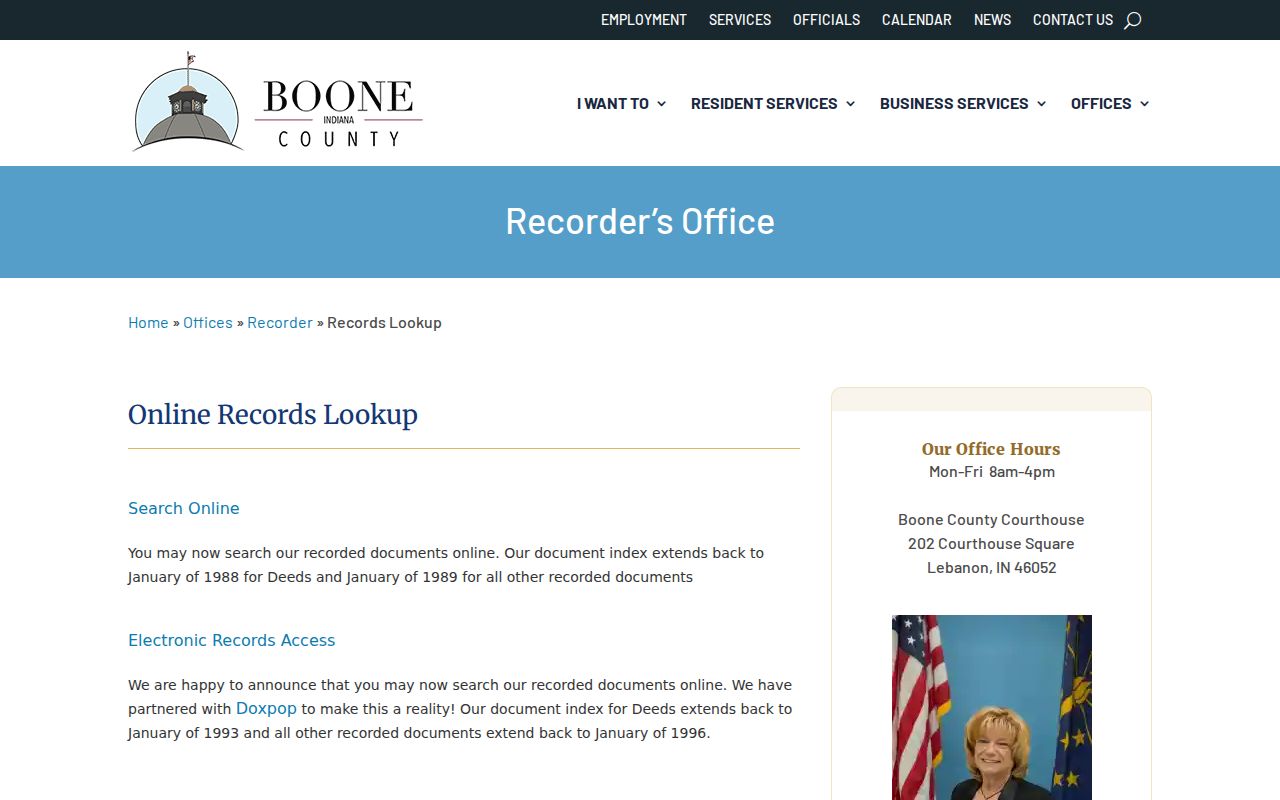
The county lookup page is the official way in. Use it, or call the Recorder, to confirm current coverage and copy options before relying on an image.
Boone County's January 1996 Coverage Conflict
Doxpop's partner table lists Boone index data and images starting January 1996. County legacy notices disagree. They describe deed coverage beginning January 1988 or January 1993, with other documents starting January 1989 or January 1996. Ask before treating one date as universal.
Online cutoff: A missing pre-1996 result does not mean no deed exists; courthouse books, microfilm, and the office index may hold it.
The Recorder scans, indexes, and microfilms documents. Indiana State Library Boone holdings and the county research guide provide added leads once a chain reaches older books.
Follow Boone County's Grantor-Grantee Trail
Start with the newest deed. Record its number, recording date, deed type, grantor, grantee, book and page, consideration, and prior-instrument reference, since deed, acknowledgment, recording, sales-disclosure, tax-transfer, and assessment dates can all differ. Label each one.
- Find the present acquiring deed with the current owner as grantee.
- Read its grantor, legal description, and cited prior conveyance.
- Search that grantor as a grantee to locate the earlier acquisition.
- Repeat until the online run ends, then request the cited deed book.
- Grantor
- The party transferring the stated interest.
- Grantee
- The party receiving that interest.
- Chain of title
- The linked sequence of conveyances for the same land.
- Book/Page and instrument number
- Two ways a recorded document may be cited.
The 1856 Boone County Record Loss
An 1856 courthouse fire destroyed nearly all pre-1856 Recorder, Auditor, and Treasurer records. A gap can break a deed chain. It is a source limit, not a search failure.
Work with what survived. Later deeds sometimes recite prior conveyances, and the Tract Book, Surveyor section-corner and tie-card records, probate dockets, newspapers with sale notices, and later tax duplicates can all help. Tag each item as direct instrument evidence, administrative evidence, or a secondary clue.
Build a missing-chain worksheet rather than forcing continuity. List the last verified deed, the exact legal description, every cited prior book and page, the probate or court case number, and the date range affected. A recital can point toward a lost conveyance. Call it a recital unless the instrument itself survives.
Plats and Easements Alongside Boone County Deeds
A subdivision plat is a recorded instrument. Planning files only show approvals. One plat can identify lots, dedications, easements, rights-of-way, setbacks, drainage, and common areas, so match its subdivision and phase name against the deed and parcel card.
The Boone Surveyor keeps legal surveys, corner records, subdivision-review files, regulated-drain records, and older tie cards. GIS can orient a search. Legal boundary questions still call for recorded documents and a professional survey.
Boone's regulated-drain guidance makes this comparison matter. An aerial can look open while a recorded plat or Surveyor file shows an easement affecting fences, landscaping, decks, accessory structures, or ponds. Pull the exhibit and any amendment or vacation.
Boone County Property Watch Alerts
Doxpop Property Watch added free SMS notices in April 2025 alongside email alerts. It tracks later deed activity by name. Skip middle initials. Misspellings, old deeds, or absent records can cause misses. An alert is a lead, not proof of fraud or a title change, so open the indexed instrument and contact the Recorder about any unexpected filing.
Obtain a Boone County Deed Copy
An online image makes the fastest reading copy when one is supplied. The Boone County Recorder remains the custodian. The office sits at 202 Courthouse Square in Lebanon. It keeps weekday hours from 8 a.m. to 4 p.m. It answers at 765-482-3070. Bring names, a number, or a book and page.
The Recorder issues official and certified copies. The Auditor can supply a name and transfer date. The Auditor then refers the deed copy to the Recorder. The office price is $1 per page; confirm it before ordering.
Recorded, not guaranteed. Boone County deed records show what reached the public record. They are not a title opinion, and unrecorded interests or later orders may matter.
The Recorder lookup page is the official handoff. It leads to the vendor and the office, and since coverage and charges may change, confirm the details before relying on any image.
Prepare a Precise Boone Recorder Request
A request to the Boone County Recorder moves faster when it names the exact instrument. Ask for one deed, not everything tied to an address. Give the party names as the index spells them. Include the document type, an approximate recording date, and the document number or book and page. Add the legal description or parcel reference. Say whether you want inspection, a plain copy, an official copy, or a certified copy. Have the office confirm the current charge and delivery method.
Older chains need a compact citation list. Mail it or bring it to the counter. Place each later deed beside every prior instrument it recites. Flag the first citation Doxpop fails to return. The Recorder can then tell a bad search apart from a book, microfilm, or pre-index record. When the chain hinges on a probate order, foreclosure judgment, or partition case, pull that public court file from the Clerk first. The resulting deed lives at the Recorder.
Keep index results and instrument images separate in your notes. The index only finds a filing. The recorded image holds signatures, acknowledgment, the legal description, exceptions, and prior references. A certified copy authenticates the office copy, yet it cannot settle every title question. A purchase, a disputed interest, or a complicated historic gap calls for expert eyes. Let a qualified Indiana title professional or attorney evaluate the full chain.
Check Boone Recording Details on the Instrument
A Boone County deed image carries more than party names because the Recorder's requirements demand real substance. Indiana conveyances and mortgages require acknowledgment under IC 32-21-2-3. The county also wants legible typed or printed names beneath signatures. The preparer's name must appear under IC 36-2-11-15(c), along with a notarial county and state, commission expiration, and seal. A conveyance may also carry Assessor sales-disclosure endorsement and Auditor transfer-tax endorsement under the cited Indiana provisions.
After a property search, these elements become verification points. Compare grantor and grantee spelling against the index. Read the full legal description and every exception. Record the execution date and the recording date separately. Follow each referenced prior instrument. For a correction deed, note exactly what changed. For a release or satisfaction, match the underlying mortgage or lien and confirm the releasing party held the stated authority.
Recording gives public notice and preserves evidence. It does not guarantee the instrument resolved every competing interest, though. A deed can coexist with easements, restrictions, mortgages, judgments, probate orders, or a later correction. Search related document families and retrieve the deed records images rather than treating the newest item labeled deed as the whole chain.
Sometimes a Boone County deed image is simply absent online. Keep the party spelling, document number, book and page, recording date, and instrument type from the index. Those fields give the Recorder enough detail. The detail can identify the official copy or the older volume. A missing portal image never means a missing conveyance.