
Compare Boone's Three Value Signals
Keep the three signals apart. Blend them and confusion follows. Indiana assesses at a 100% ratio, but that does not make the assessed total identical to the last sale price recorded against the parcel.
| Value | What It Is | Where |
|---|---|---|
| Assessed total | Tax-administration value for the stated assessment year | Assessor PRC or DLGF search |
| True tax value / market value-in-use | Current-use utility under Indiana assessment rules | Assessor and DLGF guidance |
| Recorded sale price | Amount associated with one dated conveyance or disclosure | Deed and sales disclosure |
| Land / improvements | Components explaining how the assessed total is allocated | Parcel record card |
Indiana assesses at a full 100% ratio. The DLGF's Boone County page confirms it. Assessment still rests on property characteristics, current-use rules, neighborhood data, annual trending, and statutory administration, while a sale price records one market event at one moment.
Open Boone Land and Improvement Fields
The Assessor's card page points to the county GIS. Current property-record cards and sales-disclosure PDFs live there. A live card should show the assessment year, the land and improvement assessed values, the total assessed value, and any available history.
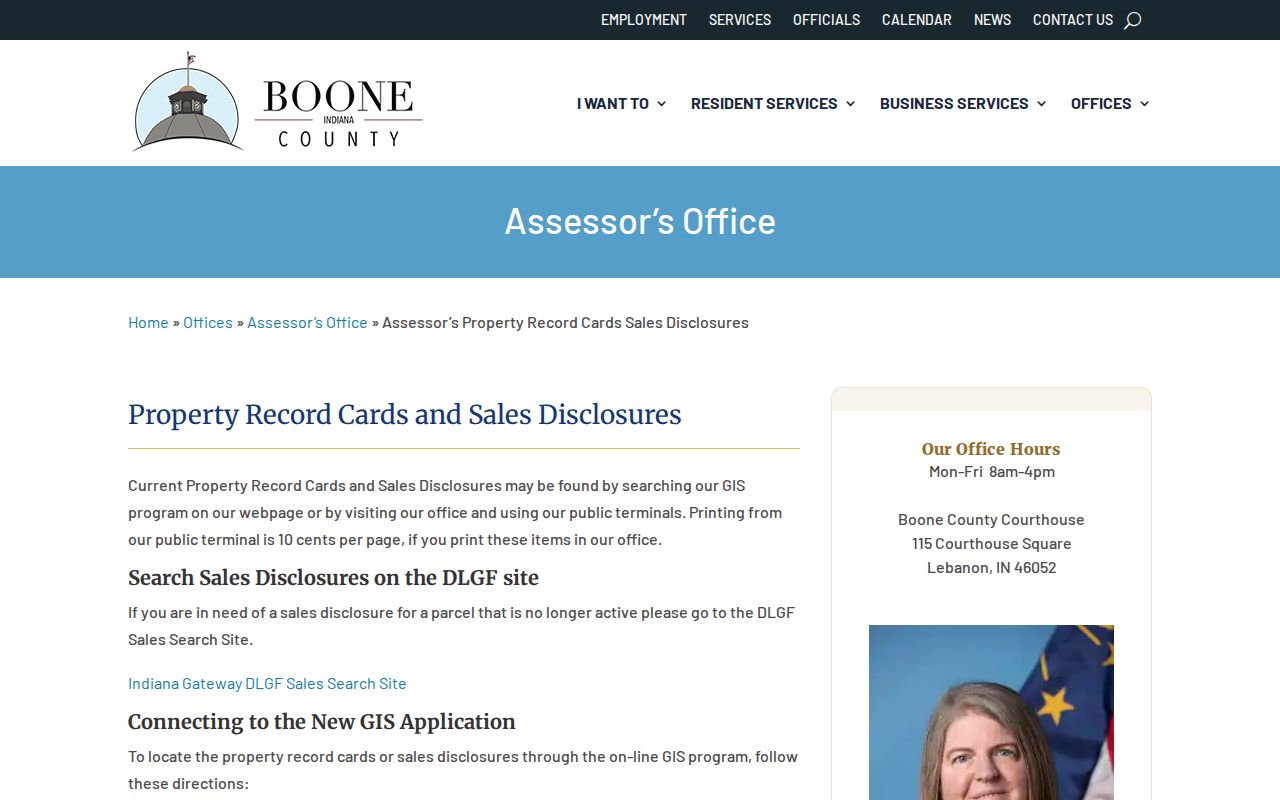
This image shows the official access route in Boone County. The parcel result, rather than the landing page, supplies each property's value evidence.
Note: If a value field is absent on the live card, mark it not displayed instead of importing an unmatched number.
Estimate Boone Value From Matched Records
Start every comparison with one verified parcel number. Otherwise a shared address can blend assessment years or attach a sale from a neighboring parcel, quietly corrupting the analysis.
- Search the address or parcel number in Boone GIS and confirm the map and legal description.
- Record the assessment year plus land, improvement, and total assessed values actually displayed.
- Open the sales disclosure or latest deed and capture its transfer date and stated consideration where available.
- Compare like years and similar property characteristics; explain any mismatch rather than averaging unlike figures.
- Assessed value
- The dollar value assigned for property-tax administration.
- True tax value
- Indiana's market-value-in-use concept, not speculative highest-and-best use.
- Assessment ratio
- The statewide 100% assessment context, not a guarantee of sale-price equality.
- Sale price
- A transaction amount attached to a dated transfer.
How Boone Trends Neighborhood Values
The Boone County Assessor studies a full year of sales, then sets a base rate for each neighborhood and trims it for location, amenities, and other influences. This is mass appraisal at work. A parcel's value can shift with no new deed at all. Once values are set, the Assessor certifies them to the Auditor. The tax rate itself is not the Assessor's call.
A sales disclosure feeds that analysis, but it is not a deed. Boone treats disclosures as public from January 2000 and points anyone researching sales of inactive parcels to the DLGF Sales Disclosure Search. Not every disclosure reflects an ordinary deal, though. Probate, partition, foreclosure, court orders, condemnation, and parcel splits can all generate Form 46021, so a disclosed amount is not always an arm's-length price.
The 2026-2030 Boone Reassessment Clock
Indiana reassesses in four-year cycles. The current one starts July 1, 2026. About 25% of parcels get physically inspected each year under the DLGF's cyclical reassessment guidance, with 2026 pay-2027 forming the first cycle year, and Boone's procurement references PRCs, plat maps, Pictometry, property-management data, and field identification.
The cycle matters when neighbors are compared. One card may show a recent physical review or newly completed improvement while another still waits for its visit. Note the assessment year and record date. Unequal values are not proof of error.
Three clocks. Place the Recorder date, Assessor assessment/transfer date, and tax pay year on one line before explaining a change.
Separate Boone Assessment Year From Pay Year
Indiana property tax is generally paid in arrears. One year's assessment supports the next year's bill, so a bare phrase like "2026 value" stays ambiguous without both labels. Statements generally mail in April. Installments fall due May 10 and November 10. Bill timing belongs to tax administration, not to the meaning of the value.
Deductions cut gross assessed value down to net assessed value. Constitutional tax caps then limit the bill by category. Neither tool changes the market evidence or the gross assessment underneath. Keep valuation analysis apart from bill math.
Why Fast Boone Development Can Stage Values
Fast growth staggers Boone County's records. In developing areas, a parent parcel, recorded plat, planning case, road or utility approval, building permit, and finished improvement can land in separate systems on different dates. Whitestown's jump from 2,867 residents in the 2010 Census to an estimated 15,767 in 2025 makes the timing gap plain.
An assessment may capture land first and improvements later. Compare the plat recording, parcel split, permit or completion context, field inspection, and assessment vintage. A mismatch across those records is a clue. Investigate it. None of that automatically means the Assessor's number is wrong.
Note: Citywide median value is context only; it does not estimate an individual Boone County parcel.
What Boone's Assessed Value Cannot Promise
Assessed value is a mass-appraisal figure built for taxation. It promises no selling price. It will not settle title. A recorded price is historical and may come from a non-standard transfer, while automated commercial estimates carry assumptions of their own.
Value versus price. A Boone County assessment is not a promise of what the parcel will sell for. Obtain a qualified property-specific appraisal when a transaction requires one.
The assessed value on a Boone property card is not the final word on everything. It cannot settle a dispute over deductions, tax bills, or the appeal procedure itself. Those live on the property-tax records page. Corrections go through the Boone Assessor's forms. Watch the Form 11 mailing date. The deadline printed on that notice controls. If the numbers need a formal challenge, this is the route.
Need a paper trail? The Assessor's office sits at 115 Courthouse Square in Lebanon. Public terminals there open up property record cards and sales disclosures. Printing runs ten cents per page. Ask by parcel number and assessment year. Keep the card you pull, printed or downloaded, along with its source date. Next year's trending is not confused with a mystery change.
Compare characteristics, not just totals. Base values by neighborhood, location, amenities, influences, land classification, and improvements. These can all separate two Boone County parcels that sit a block apart. A number alone explains nothing. The card, the sales disclosure, and the reassessment record together give the auditable answer.
Audit a Boone Property Value Change
Start with the assessment history when a Boone County property value moves. Pull the prior and current assessment years, the land and improvement figures, and the totals. Add the property characteristics and any physical-review date shown. Add to those the sales-disclosure and deed dates too. Trending, a cyclical inspection, new construction, demolition, a parcel split, or a corrected characteristic can all change an assessment. And none of them requires a sale that year.
Sort the problem into two kinds. Wrong square footage, parcel identity, improvement description, or arithmetic points to the source document. That document also shows the right correction route. A dispute over mass-appraisal judgment belongs in the Assessor's appeal process on its current calendar. Boone's Assessor works with PTABOA and publishes Form 11 and appeal guidance. The deadline on the notice controls. A comparison by itself never files an appeal.
Statewide data works as a cross-check, once you note its vintage. The DLGF Assessed Value Search carries county-reported figures with details and downloads. One tax year's assessment supports the next pay year. Bulk data calls for a schema and release-date check. Timing alone can explain a mismatch.
Before weighing a transaction, ask whether Form 46021 records an ordinary sale or something else. Probate, foreclosure, a court order, condemnation, partition, a charitable transfer, or a parcel split are all possibilities. Its consideration should never stand in as a clean comparable without context. The strongest value explanation names each number and the date it measures. It also names the record behind it.